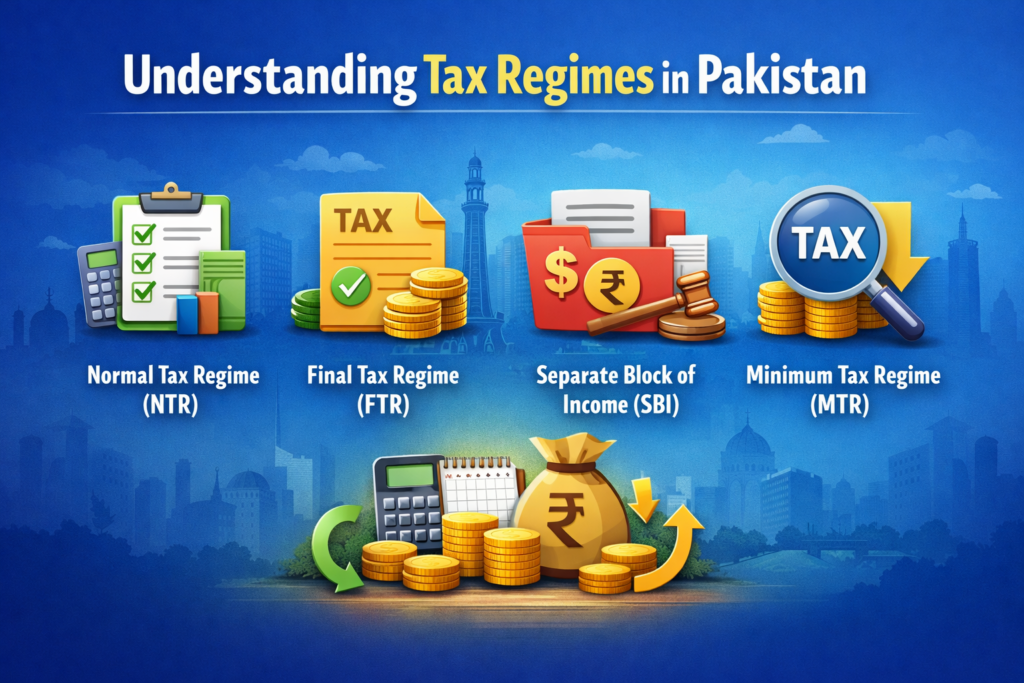
Understanding Tax Regimes in Pakistan is the first step toward accurate tax filing and efficient financial planning. While most people are familiar with the heads of income, the actual method of tax calculation depends on the specific regime your income falls under. According to the Income Tax Ordinance 2001, every taxpayer must navigate through different categories such as NTR, FTR, SBI, and MTR. By understanding tax regimes in Pakistan, you can identify whether your tax deductions are final or if you are eligible for refunds and adjustments at the end of the fiscal year.
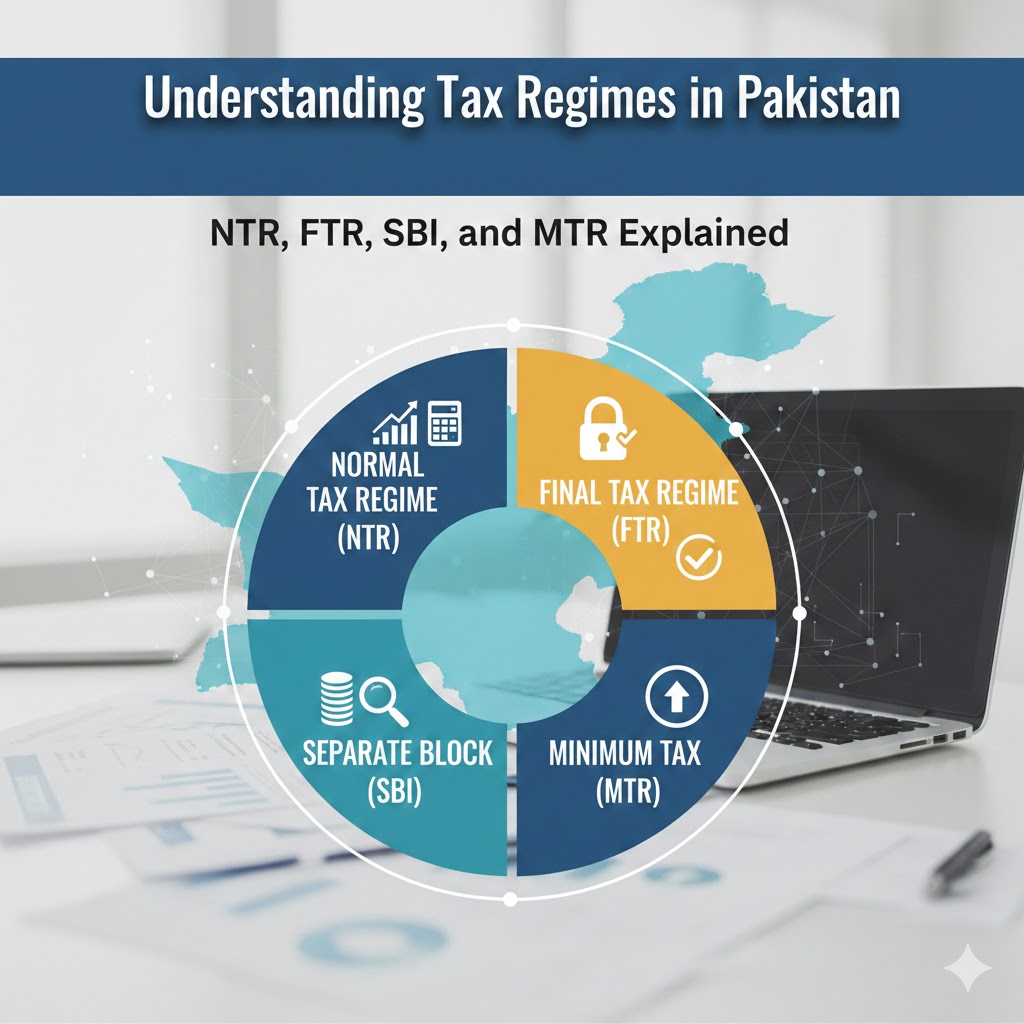
Why Understanding Tax Regimes in Pakistan is Important for You :Normal Tax Regime (NTR)
Normal Tax Regime (NTR) is important to understand because in Pakistan most taxpayers pay tax under this regime, and their tax liability is calculated according to applicable slab rates; under this system tax is assessed on total taxable income as per the relevant slabs, so understanding its concept and working mechanism helps in correctly evaluating tax liability, ensuring compliance with tax laws, and managing tax planning and return filing in an effective manner, while tax rates and slabs are updated every year through the budget announced by the Federal Board of Revenue.
Different Categories Under Tax Regimes in Pakistan : Key Concepts
Adjustable tax : refers to the tax that has already been deducted during the year, such as tax deducted on vehicle token payments, phone bills, electricity bills, or any other advance tax that is adjustable in nature. This deducted tax can be adjusted against your total tax liability under the Normal Tax Regime (NTR). After adjustment, the remaining amount becomes your actual tax payable, and the final tax is calculated after subtracting the adjustable tax from the total liability. This mechanism ensures that tax already paid in advance is properly accounted for and reduces the overall tax burden where applicable under the tax laws of Pakistan.
Expense deduction allows businesses to subtract their legitimate and allowable expenses—such as rent, salaries, electricity, and other administrative costs—that are permitted under the provisions of the Income Tax Ordinance 2001. After deducting these expenses, the remaining amount, known as net profit, becomes the taxable income on which tax is calculated. This mechanism ensures that tax is applied only on actual profits rather than gross revenue, in accordance with the tax laws of Pakistan.
Tax slabs are not fixed; if your income is low, the tax rate may be 0%, and if it is higher, it can go up to 35% depending on the applicable slabs. These tax slabs are updated every year in the budget, and any changes announced in the budget are applied to the new slabs for businesses and taxpayers. If you are filing a return for 2026, you must check the updated tax slabs under the provisions of the Income Tax Ordinance 2001 and calculate your tax liability according to the revised rates. The applicable slabs depend on the annual budget updates, and tax liability is determined based on the rates in effect for that tax year in Pakistan.
Detailed Concept of NTR Sections
Under the concept of Understanding Tax Regimes in Pakistan, the Normal Tax Regime (NTR) operates through different sections that allow taxpayers to adjust their income and expenses for tax calculation. Under Section 12 (Salary), salaried individuals are taxed on a progressive slab basis, where income up to a certain threshold (for example, PKR 600,000) may be tax-free, and tax is applied progressively as salary income increases beyond that limit. Under Section 15 (Income from Property), rental income is also included in the Normal Tax Regime, and taxpayers are allowed to deduct up to one-fifth of rental income for maintenance and repairs as an allowable expense. Similarly, under Section 18 (Income from Business), business profits are subject to taxation, but Section 20 permits deductions for all legitimate business expenses so that tax is calculated on net profit instead of gross revenue. Lastly, Section 39 (Income from Other Sources) covers any income that does not fall under the other heads, and the total of all these sections constitutes the taxpayer’s overall taxable income, which is taxed according to the applicable annual slabs under the provisions of the Income Tax Ordinance 2001 in Pakistan.
NTR Tax Slab Rate 2026
| Income Range (PKR) | Tax Rate |
|---|---|
| Up to 600,000 | 0% |
| 600,001 – 1,200,000 | 5% |
| 1,200,001 – 2,400,000 | 10% |
| 2,400,001 – 3,600,000 | 15% |
| Above 3,600,000 | Up to 35% |
Note: Actual slab rates are announced by the Federal Board of Revenue (FBR) in the annual budget. Please verify current rates before calculating tax liability.
Final Tax Regime (FTR)
The Final Tax Regime typically applies to incomes such as exports (Section 154), prize bonds (Section 156), dividends (Section 150), and profit on debt earned from bank investments or savings accounts. The major disadvantage of this regime is that no tax adjustment or refund can be claimed because the tax deducted is considered the final liability. However, its advantage is that taxpayers are not required to maintain extensive records or undergo detailed audits, as their tax obligations are settled at the time of payment.
It is also important to note that tax rates under FTR may differ depending on filer and non-filer status as maintained in the Active Taxpayers List (ATL). Filers generally enjoy lower tax rates, while non-filers are subject to higher rates as determined by the regulations of the Federal Board of Revenue. This distinction encourages taxpayers to maintain compliance and file returns regularly in accordance with tax laws in Pakistan.
Final Tax Regime (FTR) Tax Rates 2026
Tax under FTR is final and not adjustable or refundable as per Income Tax Ordinance 2001.
| Income Source | Tax Rate (Filer) | Tax Rate (Non-Filer) |
|---|---|---|
| Exports (Section 154) | 1% (Example) | 2% (Example) |
| Dividends (Section 150) | 15% (Example) | 30% (Example) |
| Prize Bonds (Section 156) | 15% (Example) | 30% (Example) |
| Profit on Debt (Bank Interest) | 15% (Example) | 30% (Example) |
Note: Actual tax rates are announced by FBR every year. Update these values when official rates are released.
Separate Block of Income (SBI)
Under the concept of Understanding Tax Regimes in Pakistan, the Separate Block of Income (SBI) is a special category that covers income which is not taxed under normal slab rates but is instead taxed at fixed rates prescribed by the government, and these rates cannot be altered by the taxpayer. This regime mainly applies to incomes such as Capital Gains on Immovable Property and Profit on Debt, where tax calculation is independent of other income sources.
In the SBI regime, income is not combined with salary or business income for tax calculation; rather, it is taxed separately at the applicable rates. For example, if you sell a plot or property, the tax treatment depends on the holding period of the asset instead of your total annual income. If the property is sold within the specified period, tax will be applied according to the rules governing capital gains. In some cases, if the holding period exceeds the defined threshold, the gain may even become tax-exempt under the provisions of the Income Tax Ordinance 2001.
Unlike the Normal Tax Regime, expenses are generally not deductible under SBI, and the tax is calculated on the gain itself. This separate treatment helps in managing taxation on large assets in a structured manner and ensures that tax liability is determined based on asset-specific rules rather than overall income. The SBI mechanism allows for a fair and simplified taxation approach for capital transactions while maintaining compliance with tax regulations in Pakistan.
Minimum Tax Regime (MTR)
Under the concept of Understanding Tax Regimes in Pakistan, the Minimum Tax Regime (MTR) works as a safety net introduced by the Federal Board of Revenue for businesses that either declare a loss or show very low profitability. According to Section 113 of the Income Tax Ordinance 2001, if a business’s turnover exceeds a specified threshold, it is required to pay minimum tax on its total sales at a fixed rate (generally 1.25%), regardless of whether the business has made a profit or incurred a loss. The core principle of this regime is that if the normal tax calculated under the NTR is lower than the minimum tax, the taxpayer must pay the minimum tax amount. However, an important advantage of MTR is that if the minimum tax paid is higher than the normal tax liability, the excess amount can be carried forward for up to five years and adjusted against future tax liabilities when the business generates higher profits. This regime applies to individuals, associations of persons (AOPs), and companies whose turnover meets the prescribed conditions, ensuring that government revenue is maintained even in cases of low or negative profitability in Pakistan.
Minimum Tax Regime (MTR) Tax Rate 2026
Minimum tax applies on turnover when normal tax liability is lower. This tax is payable as per Income Tax Ordinance 2001.
| Turnover Condition | Tax Rate (MTR) | Remarks |
|---|---|---|
| Turnover above threshold | 1.25% (Example Rate) | Minimum tax on total sales |
| Normal Tax < Minimum Tax | 1.25% Payable | Minimum tax applies |
| Excess Minimum Tax Paid | Carry Forward | Adjustable in next 5 years |
Note: Actual tax rates and turnover thresholds are announced by FBR every year. Update rates as per official notifications.
Final Summary of Understanding Tax Regimes in Pakistan
Understanding Tax Regimes in Pakistan is not only important for tax optimization but also for legal compliance and proper financial management. Whether your income falls under the Normal Tax Regime (NTR) or you are paying fixed tax under the Final Tax Regime (FTR), each regime has its own rules and benefits. A clear understanding of NTR, FTR, SBI, and MTR helps you file your tax return accurately and avoid notices or compliance issues from the Federal Board of Revenue. Since tax laws are frequently updated, it is always advisable to consult a qualified tax advisor before making financial decisions. Proper knowledge of these regimes not only ensures legal compliance but also contributes to better financial planning and sustainable economic growth in accordance with the provisions of the Income Tax Ordinance 2001.
Disclaimer
Disclaimer
The information provided in this article is for general informational and educational purposes only. It is based on the Income Tax Ordinance 2001 and applicable tax laws at the time of writing. Tax laws and regulations may change from time to time, and their interpretation may vary depending on individual circumstances.
This content does not constitute legal, financial, or tax advice. Readers are advised to consult a qualified tax professional or relevant authorities before making any tax-related decisions. The author and publisher shall not be held responsible for any loss, liability, or penalty arising from the use of this information.