
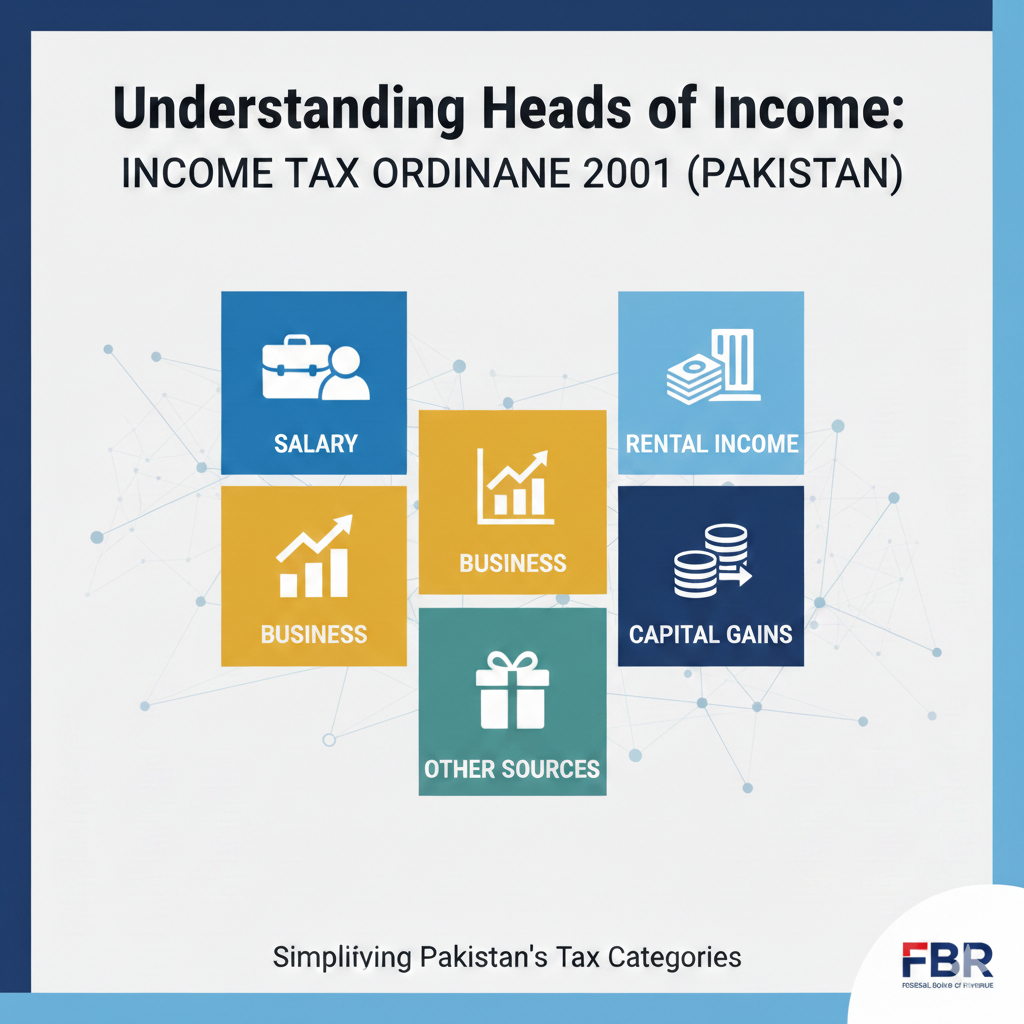
5 Heads of Income under Income Tax Ordinance 2001 form the basis of the entire taxation system in Pakistan. According to the Income Tax Ordinance 2001, the tax system has a broad and comprehensive framework. To understand this system properly, it is essential to first look at the 5 Heads of Income under Income Tax Ordinance 2001, as these are the core components on which the entire tax structure is built.
One of the most important concepts to keep in mind is the five main heads of income. Understanding these heads is considered fundamental for anyone dealing with taxation. The Federal Board of Revenue (FBR) has separated different types of income into distinct categories to ensure transparency in tax calculations and to assess tax liability fairly and accurately.
Whether you are a salaried individual, running your own business, or earning rental income from property, your income will fall under one or more of these heads. By clearly understanding their essence, you can file your tax return correctly and determine your legal tax liability with confidence.
For further clarity, I will briefly explain the five heads of income below so that any questions in your mind can be addressed.
Salary (Section 12)
Under the Salary head, it is not only the monthly salary that is considered. It also includes every benefit and allowance provided by the employer in addition to basic pay. All monetary and non-monetary benefits given to an employee as part of their employment are treated as salary.
To explain this clearly, the key points have been highlighted in accordance with the Income Tax Ordinance 2001, as they are legally defined and included under the law.
Basic Pay & Allowances:
Your basic salary is not the only amount considered under the Salary head. It also includes all additional payments received in the form of allowances, such as house rent allowance, medical allowance, utility allowance, and other similar benefits.
Bonuses & Commissions:
Any annual bonus or performance-based commission you receive is also treated as part of your salary and is taxable accordingly.
Perquisites (Benefits):
If your employer provides benefits such as a company car, rent-free accommodation, or any other facility, the market value of those benefits is calculated and added to your salary for tax purposes.
Arrears:
If you receive unpaid salary from a previous year during the current tax year, that amount will also be taxed under the Salary head
Gratuity and Pension:
Amounts received at the time of retirement, such as gratuity or pension, are subject to specific tax rules as prescribed under the Income Tax Ordinance 2001.
Tax Rate
Tax on salary is calculated according to the applicable slab rates, which are announced every year in the federal budget by the Federal Board of Revenue (FBR).
For example, if your annual income is below PKR 600,000, no tax is charged, as this amount falls within the tax-free threshold.
Income from Property (Section 15)
If you own land, a building, or any other taxable property and have leased or rented it out in return for rental income, the amount you receive is treated as Income from Property in accordance with the Income Tax Ordinance 2001.
This classification applies to all rental income derived from immovable property and is subject to tax under the relevant provisions of the law.
Annual Rent:
The amount that you receive, or are entitled to receive (receivable), during the year in the form of rent is referred to as annual rental income. This annual rent is then assessed according to the applicable slab rates to determine the tax liability payable on the rental income.
Non-Adjustable Advance:
This refers to the advance amount received from the tenant at the time of the agreement, which is not adjustable against future rent or refundable at the end of the tenancy. Under the tax rules, one-tenth (1/10th) of this advance amount is treated as income each year and is included in taxable income for a period of ten years.
Fair Market Rent
The concept of Fair Market Rent ensures that rental income is assessed on a reasonable market-based value. However, due to variations in area-wise rental rates and practical complications, actual implementation may differ. If you rent out a property free of cost or at a significantly lower rent, the Federal Board of Revenue (FBR) may assess tax based on the fair market rent of similar properties in that area for the purpose of taxation.
Deductions (Individuals vs. Companies):
Previously, individuals were not allowed to deduct expenses, and tax was calculated on gross rental income. However, under the updated rules, individuals can now claim certain deductions if they opt for the Normal Tax Regime.
Companies, on the other hand, are permitted to deduct expenses such as repairs, insurance, property tax, and legal charges before calculating taxable income from property.
Income from Business (Section 18)
Business income does not only refer to large factories or major industries. It also includes earnings from small shops, startups, and all types of commercial activities that fall within the tax net.
If a person’s profit exceeds PKR 600,000 under the provisions of the Income Tax Ordinance 2001, it is generally accounted for under the Business Income head. Whether someone is a freelance developer, a consultant, a trader, or running a small retail shop, the income generated from these activities is treated as business income for tax purposes.
This head covers a wide range of profit-based activities and is subject to tax in accordance with the applicable laws and regulations.
Scope of Business
Profits & Gains:
After completing business activities for the year, tax is applied to the net profit that remains. This is calculated by deducting allowable business expenses from total revenue. The remaining amount represents the actual profit of the business, and tax is charged on this net income in accordance with the applicable tax laws.
Services (Professional Income)
Professional fees received by consultants, doctors, and other service providers are treated as revenue. However, tax is not charged on the gross revenue amount.
First, all allowable business expenses—such as office rent, staff salaries, utilities, equipment costs, and other operational expenses related to providing services—are deducted from the total revenue. After deducting these expenses, the remaining amount represents the net income.
Tax is then calculated on this net income, which determines the actual tax liability. Once the tax is paid, the remaining amount is considered the professional’s net profit. This net profit ultimately contributes to the individual’s wealth accumulation.
Trade Associations:
Income earned by a trade association is generally treated in a manner similar to service income. The total receipts are first recorded as revenue; however, tax is not charged on the gross revenue amount.
Before calculating tax, all allowable expenses—such as office expenses, administrative costs, staff salaries, utilities, and other operational expenditures—are deducted from the total revenue. After subtracting these expenses, the remaining amount represents the net income.
Tax is then calculated on this net income, which determines the actual tax liability. Once the tax has been paid, the remaining amount is treated as net profit. This profit ultimately contributes to the association’s accumulated funds or overall wealth.
Important Rules:
Record Keeping:
To properly declare business income, it is essential to maintain complete and accurate records of all receipts and expenses. Proper documentation, including invoices, bills, and financial statements, helps ensure transparency and supports your declared income in case of audit or verification.
Separate Tax Treatment:
Certain businesses are subject to a Final Tax Regime, where tax is deducted at specific prescribed rates—for example, in the case of exports or certain imports. In such cases, the deducted tax may be treated as full and final discharge of tax liability on that income.
However, most businesses fall under the Normal Tax Regime, where tax is calculated on net profit after deducting allowable expenses in accordance with the applicable tax laws.
Capital Gains
Capital Gains are defined under Section 37 of the Income Tax Ordinance 2001. This type of income arises when you sell a capital asset—such as shares, plots, property files, or jewelry—and earn a profit from its disposal.
The calculation method is straightforward. The sale price of the asset is reduced by its original purchase cost and any related selling expenses, such as brokerage commission or transfer fees. The remaining amount is referred to as the taxable capital gain.
In Pakistan, the tax treatment of immovable property (land or buildings) and shares differs slightly. For example, when you sell a plot or property after holding it for a specific period, the applicable tax rate may decrease as the holding period increases. In certain cases, after a defined holding period, the gain may become fully exempt from tax.
Similarly, profits earned from trading shares on the stock exchange are also treated as capital gains. The Federal Board of Revenue (FBR) announces applicable tax rates for such gains each year through the federal budget.
An important point to note is that if you incur a loss on the sale of a capital asset (Capital Loss), you may adjust that loss against other capital gains in the same tax year to reduce your overall tax liability. However, capital losses cannot be adjusted against salary income or business income.
Income from Other Sources
Income from Other Sources, as defined under Section 39 of the Income Tax Ordinance 2001, is considered a residual category. It includes all types of income that do not fall under the other four heads: Salary, Property, Business, or Capital Gains.
This head generally covers income such as profit earned on bank deposits, dividends received from companies, winnings from prize bonds, lottery proceeds, certain types of gifts, and royalties.
One important feature of this category is that if you have incurred any legitimate expense to earn such income (excluding personal expenses), you may deduct that expense from your total income. For example, if you rent out machinery along with equipment, the income may fall under this head, and related depreciation can also be claimed as a deduction where applicable.
In many cases, income under “Other Sources” is taxed under the Final Tax Regime (FTR). This means that tax is deducted at source—such as by a bank on profit or on prize bond winnings—and the deducted amount is treated as your final tax liability on that income. However, in certain situations, such income may be taxed under the Normal Tax Regime, where it is included in total income and taxed according to the applicable annual slab rates.
Conclusion
In conclusion, it is important to understand that the 5 Heads of Income under the Income Tax Ordinance 2001 form the foundation of the tax system in Pakistan. Your overall tax liability—how much tax you are required to pay—is determined based on how your income is classified under these heads.
If you fail to categorize your income correctly, you may end up paying excess tax or facing penalties under Section 182 of the Income Tax Ordinance 2001. Therefore, whether your income arises from salary, rental property, or business profits, you should always prepare your wealth statement and file your tax return in accordance with the five Heads of Income prescribed by law.
In addition, it is essential to review the relevant provisions under the Income Tax Rules, 2002, to ensure that no specific rule applies to your situation. By following these rules properly, you can not only become a responsible and compliant filer but also manage your tax affairs more effectively and lawfully.
The information provided in this article is for general educational and informational purposes only. It is based on the Income Tax Ordinance 2001 and related rules applicable in Pakistan at the time of writing. Tax laws and regulations may change from time to time, and their application may vary depending on individual circumstances.
This content does not constitute legal, financial, or tax advice. Readers are advised to consult a qualified tax professional or refer to official sources before making any tax-related decisions. The author shall not be held responsible for any loss, liability, or penalty arising from the use of this information.